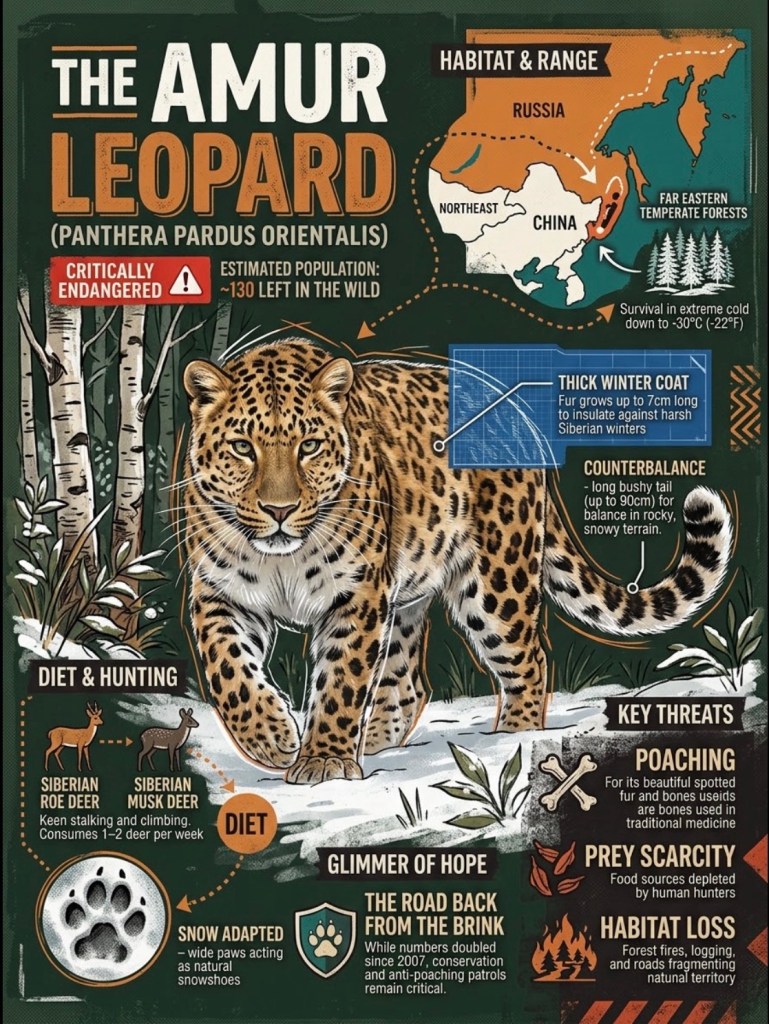
With fewer than 130 individuals remaining in the wild, the critically endangered Amur leopard battles poaching, habitat fragmentation, and prey scarcity in the freezing temperate forests of the Russian Far East and Northeast China. Dedicated conservation efforts offer a fragile glimmer of hope for this resilient, snow-adapted predator.
Often referred to as the “silent ghost” of the northern forests, the Amur leopard (Panthera pardus orientalis) is one of the world’s most endangered big cats. Unlike their tropical cousins across Africa and Southern Asia, these extraordinary felines have adapted to endure harsh Siberian winters where temperatures regularly plunge below -30°C (-22°F). Their dense winter coats, wide paws that function like natural snowshoes, and long, bushy tails for balance allow them to navigate steep, snow-covered ridges with effortless agility.
Historically roaming across the Korean Peninsula, northeast China, and the Russian Far East, relentless poaching, prey depletion, and forest fires drastically shrank their habitat, pushing the species to the brink of extinction with fewer than 35 individuals in the early 2000s.
Thanks to rigorous anti-poaching patrols, protected reserves like Russia’s Land of the Leopard National Park, and international cross-border monitoring with China, their numbers have climbed back to roughly 130 in the wild. While still critically endangered, this gradual recovery proves that targeted conservation can pull even our planet’s most vulnerable species back from the edge.


Leave a Reply